
Population trends for Turtle Dove in the UK and England, to 2025
This page hosts the Official Statistic 'Population trends for Turtle Dove in the UK and England', published on 11 December 2025.
Official Statistic description
- This publication presents indices of Turtle Dove population trends in England and in the UK, showing change in population between 1994 and 2025. The statistics are based on data gathered through the BTO/JNCC/RSPB Breeding Bird Survey (BBS), which is a long-term citizen science monitoring scheme involving annual sampling at thousands of sites across the UK. The BBS reports population trends annually for over 100 UK breeding bird species.
- Turtle Dove trends are being published separately before the main BBS Official Statistics to allow use for operational purposes to inform conservation. Trends are presented for the UK and England. Trends are reported for the duration of the BBS (1994–2025), and for more recent shorter time periods (1-year, 5-year, and 10-year).
- The statistic is being published in near final form. Later arriving additional data from a very small number of sites will be included as part of the main annual BBS Official Statistics, expected to be published in Spring 2026. These data are extremely unlikely to result in an appreciable change in the Turtle Dove statistic published here.
- The survey methods and analytical methods are the same as those used for the BBS, and are described in Section 5 (Methods), below.
- The Breeding Bird Survey is a Partnership jointly funded by the British Trust for Ornithology (BTO), the Joint Nature Conservation Committee (JNCC) and the Royal Society for the Protection of Birds (RSPB). The BBS is indebted to the thousands of volunteer data recorders who take part.
Scope of statistics
- The statistics are presented for the UK and for England. Sample sizes are currently insufficient to produce these statistics at the level of any individual region.
Involvement and contacts
- The statistic was produced by the Breeding Bird Survey partnership, with BTO having primary responsibility.
- Quality assurance was by BTO, JNCC and RSPB. Additional information on quality assurance and BBS methods is provided in Section 5 (Methods), below.
- The data are published as a JNCC Official Statistic. If you have any queries, please contact us.
Relation to other Official Statistics/National Statistics
- The Turtle Dove statistics are normally published as part of the annual BBS Official Statistics publication. The BBS reports population trends annually for over 100 UK breeding bird species.
- Statistics from the BBS are normally published in the spring of the year following data collection. To enable use for operational purposes, the Turtle Dove statistic is being published separately before the full BBS publication. The same information on Turtle Dove will be included as part of the full BBS publication, expected to be Spring 2026.
- The BBS results form part of a suite of statistics from partnership monitoring schemes in JNCC’s terrestrial evidence programme – see our official statistics webpage. These statistics feed into the UK Biodiversity Indicators.
Methods
- 2,820 volunteers took part in the Breeding Bird Survey (BBS) in 2025, covering 4,054 1-km square sites across the UK.
- Each 1-km square is visited twice by a volunteer between April and June, and all birds encountered while walking two 1-km line transects are recorded.
- For the UK, a population trend is produced for species recorded on at least 40 survey squares on average over the trend period. For England, trends are produced when the species is recorded on at least 30 squares on average over the trend period. Species that no longer fulfil these criteria, but that have done previously, continue to be published.
- Population changes are estimated using a log-linear model with Poisson error terms. Counts are modelled as a function of year and site effects, weighted to account for differences in sampling densities across the UK, with standard errors estimated by bootstrapping.
- The trend is statistically significant where the 95% confidence limits of the change do not overlap with zero.
- The long-term trends cover the lifetime of BBS. 10-year, 5-year, and 1-year trends cover the most recent periods. Trends have been smoothed, and the end years truncated because at the two ends of the series the smoothed population index is very sensitive to fluctuations of the unsmoothed index. As such, although data from 1994 and 2025 are used to create the smoothed index values, the long-term trend period is calculated from 1995–2024.
- More detail on survey methods and analytical approaches is available at:
- The BTO Breeding Bird Survey website (Methodology and Survey design)
- Massimino et al. (2025). The Breeding Bird Survey of the United Kingdom. doi.org/10.1111/geb.13943
Summary of results
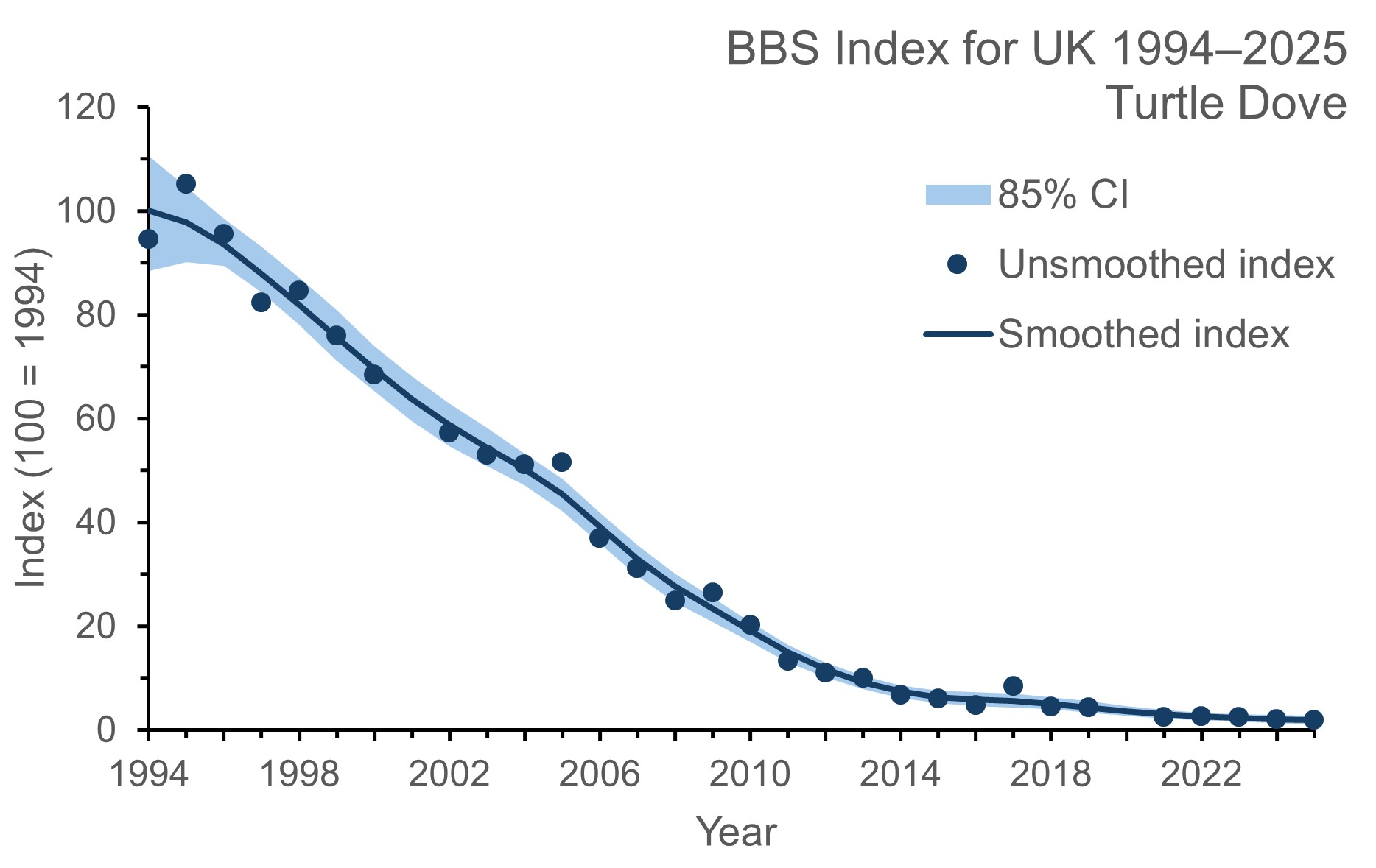
The graph below (Figure 1) shows the trend for the UK Turtle Dove population index, from the beginning of the BBS time series.
Figure 1. BBS Index for Turtle Dove in the UK (1994–2025)
Notes:
- Legend: Dots = Unsmoothed indices; solid line = smoothed index; shading = 85% confidence interval.
- The 85% confidence interval is shown to allow approximate visual comparisons between years. If 85% confidence intervals for any two selected years do not overlap, the difference between these years will (in general) be statistically significant at p < 0.05.
The table below (Table 1) shows the trend of the Turtle Dove population index over several time periods.
Table 1. Trends in the Turtle Dove Population Index
| Turtle Dove | 1-year trend (2024-25) |
5-year trend (2019–24) |
10-year Trend (2014–2024) |
29-year trend (1995–2024) | |||||
| Region | Change | LCL, UCL | Change | LCL, UCL | Change | LCL, UCL | Change | LCL, UCL | n |
|
UK
|
-12 | -71, 92 | -53* | -72, -29 | -72* | -84, -57 | -98* | -99, -97 | 100 |
| England | -12 | -72, 110 | -52* | -74, -25 | -72* | -84, -57 | -98* | -99, -97 | 99 |
Table notes:
- * = Statistically significant change – the 95% confidence limits of the change do not overlap with zero.
- LCL = Lower 95% confidence limit.
- UCL = Upper 95% confidence limit.
- n = Average number of BBS squares on which turtle dove was recorded over the duration of the trend period.
- The population trend for Turtle Dove in the UK is one of sharp decline, with a 98% reduction since 1994. Of the 119 species monitored by BBS, Turtle Dove shows the largest UK decline of any species over the period of monitoring.
- The breeding distribution of Turtle Dove from the Bird Atlas period 1988–91 covered most of Britain south and east of a line between the rivers Severn and Tyne. The more recent Bird Atlas (2007–11) saw that range contract largely to southern and eastern counties of England. The most recent survey for Turtle Dove (Stanbury et al. 2023) observed an additional substantial range contraction from 2007–11 and estimated the UK population at 2,092 (1,559–2,782) territories in 2021.
- These data for Turtle Dove – which are published in advance of the remaining 118 UK species – contribute to reporting being undertaken on behalf of the European Commission to assess the impact of hunting moratoria along the Western European Flyway that came into force in 2021. Initial results – published in February 2024 – indicated that hunting restrictions had a positive effect along the Western Flyway, with the number of breeding pairs of Turtle Dove increasing along this Flyway since 2021 (Carboneras et al. 2024). Meanwhile, Turtle Dove abundance along the Central European Flyway, where no restrictions were in place, continued to decline.
- Following another year of monitoring across Europe, the 2024 breeding season saw yet another increase in the Western Flyway, with an estimated increase in the number of breeding pairs of 40.5% – equivalent to 615,000 breeding pairs – since the low of 2021 (Carboneras et al. 2025).
- In 2025, the moratoria put in place across France, Spain and Portugal was lifted, with limits of a 1.5% quota. The effects of the quota will be enforced by national authorities and closely monitored (EC, 2025). This latest dataset therefore comprises the UK contribution to the ongoing monitoring of Turtle Dove in the Western Flyway before, during and after the moratoria.
- The data are provided in a spreadsheet and are available under Open Government Licence. Attribution statement: Breeding Bird Survey (BBS) data © copyright and database right 2025. BBS is a partnership jointly funded by the BTO, JNCC and RSPB, with fieldwork conducted by volunteers.
- For more information on Turtle Dove, including causes of change, see the BTO webpage on Turtle Dove, and the European Union’s action plan for the conservation of the European Turtle Dove.
Confidence in results and caveats
- The survey and analytical approaches follow standardised peer-reviewed methods to ensure results are comparable between survey sites and over time. All data undergo a combination of automated and manual validation and verification.
- Data collection was much reduced during 2001 due to the foot-and-mouth disease outbreak and during 2020 due to Covid restrictions on fieldwork (Gillings et al. 2022), and the data collected had spatial and temporal biases. To avoid biasing subsequent results, 2001 and 2020 data are not used in the analyses and the unsmoothed index for the two years is not given. However, it is still possible to provide a smoothed index for 2001 and 2020 because this is estimated by interpolating the index along all remaining years. For more details, please see the BBS report for 2020 (pages 10–11).
- Whilst trends are published at the UK and England levels, due to the limited distribution of Turtle Dove almost exclusively to England through the time covered by the survey, the UK trend is almost indistinguishable from the England trend.
- Because of the dramatic decline, recent Turtle Dove occupancy on BBS squares is now very low – sample size has declined from over 200 in the late 1990s to 8 in 2025. For this reason, it is becoming increasingly difficult to estimate short-term changes.
References
Carboneras, C., Cruz-Flores, M., Colomer, M.A., Šilarová, E., Škorpilová, J., & Arroyo, B. (2024) Turtle Dove Adaptive Harvest Management mechanism March 2024 Technical update (western flyway).
Carboneras, C., Rubio, B., Cruz-Flores, M., Guillemain, M. & Arroyo, B. (2025) TFRB 25-03-02 March 2025 annual review Turtle Dove AHMM Management scenarios and technical recommendation (western and central flyway).
European Commission (2025) Parliamentary question – E-001381/2025(ASW).
Gillings, S., Balmer, D.E., Harris, S.J., Massimino, D., Pearce-Higgins, J.W. (2022) Impacts of COVID-19 restrictions on capacity to monitor bird populations: a case study using the UK Breeding Bird Survey. Bird Study, 68, 220–232. doi.org/10.1080/00063657.2021.2019187
Massimino, D., Baillie, S.R., Balmer, D.E., Bashford, R.I., Gregory, R.D., Harris, S.J., Heywood, J.J.N., Kelly, L.A., Noble, D.G., Pearce-Higgins, J.W., Raven, M.J., Risely, K., Woodcock, P., Wotton, S.R. & Gillings, S. 2025. The Breeding Bird Survey of the United Kingdom. Global Ecology & Biogeography, 34, e13943. doi.org/10.1111/geb.13943
Stanbury, A. J., Balmer, D. E., Eaton, M. A., Grice, P. V., Khan, N. Z., Orchard, M. J., & Wotton, S. R. (2023). The status of the UK breeding European Turtle Dove Streptopelia turtur population in 2021. Bird Study, 70(4), 183–194. doi.org/10.1080/00063657.2023.2256511
Published: .