
Please be advised that as of 16 October 2025, new fisheries measures will be in force for Geikie Slide and Hebridean Slope Nature Conservation MPA. The fisheries measures for this site are demersal mobile gear prohibited in three zonal areas. For more information about these fisheries measures please see 'Offshore Marine Protected Areas - fisheries management measures: supporting guidance on coordinates and restrictions' on the Scottish Government website.
Please be advised the conservation advice package for Geikie Slide and Hebridean Slope NCMPA was published on December 2025. This is JNCC's formal conservation advice for the site and can be accessed via the conservation advice section of this Site Information Centre.
Please not that the structure of this conservation advice package has been revised to support ease of access and understanding for users. More detail is provided in the conservation advice section below.
Status: Nature Conservation Marine Protected Area (Nature Conservation MPA)
Located to the north-west of Scotland, the Geikie Slide and Hebridean Slope MPA follows the descent of the seabed from the Hebridean continental shelf at a depth of 200 m into the deep sea of the Rockall Trough.
Video
Site
The Geikie Slide and Hebridean Slope MPA is located to the north-west of Scotland and follows the descent of the seabed from the Hebridean continental shelf at a depth of 200 m into the deep-sea of the Rockall Trough. The Slide is a geological submarine landslide, named after the famous Scottish geologist, Sir Archibald Geikie.
Map displaying the Geikie Slide and Hebridean Slope MPA boundary and associated protected feature data. Visit JNCC's MPA Mapper to further view and explore data for this MPA.
Legislation
Legislation behind the designation: Marine and Coastal Access Act (2009)
Protected Features
| Feature | Feature Type |
| Burrowed mud (sea-pen and burrowing megafauna communities) | Habitat |
| Offshore subtidal sands and gravels | Habitat |
| Offshore deep-sea muds | Habitat |
| Continental slope | Large scale feature |
| Slide deposit and slide scars representative of the Geikie Slide Key Geodiversity Area | Geomorphological feature |
Specific information on the conservation objectives relating to this site is provided in the Conservation Advice section.
The acquisition of new data may result in updates to our knowledge on feature presence and extent within this site. The most up-to-date information is reflected on the map at the top of the section and in JNCC's MPA mapper, with the evidence underpinning available in the Monitoring and Evidence section.
Site Timeline
The diagram below is a summary of the key milestones involved in the selection and designation of the Geikie Slide and Hebridean Slope. More detail can be found in the Relevant Documentation section.
Relevant Documentation
The documents referred to below and any other historical documents relating to Geikie Slide and Hebridean Slope were produced during the selection and designation process and therefore may be out of date. This Site Information Centre is the most up-to-date source of information for this MPA, and will reflect any additional information gathered since these documents were produced. Information about the Nature Conservation MPA site selection process is available on the JNCC Nature Conservation MPA webpages.
- Site Summary Document – Overview of the site and the protected features
- Data Confidence Assessment – Sets out JNCC's confidence in the presence and extent of the protected features
- Assessment against MPA Selection Guidelines – Details the application of the five stages of the Scottish MPA Selection Guidelines
- Management Options Paper – Considers the management options for achieving the Conservation Objectives for each of the protected features in the MPA.
- Designation Order – Scottish Ministerial Order for the designation, including MPA boundary coordinates, and information on Conservation Objectives.
- Business Regulatory Impact Assessment – An assessment of the environmental, social and economic costs and benefits of the designation.
- JNCC’s formal conservation advice for this site is available in the Conservation Advice section.
Summary
Last updated: June 2017
Information for this site summary was adapted from the Site Summary Document and incorporates any further information gathered since this document was produced. Please refer to this document in the Relevant Documentation section for further details and information sources.
Site overview
Located to the north-west of Scotland, the Geikie Slide and Hebridean Slope MPA follows the descent of seabed from a depth of 200 m on the Hebridean continental shelf into the deep-sea of the Rockall Trough. Habitats within the MPA vary down the slope with the descent into deeper, calmer water. The purpose of the MPA is to represent variation in sandy, muddy and gravelly habitat types, and the animal communities they support, with depth. The Geikie Slide is a submarine landslide of geological importance, named after the famous Scottish geologist, Sir Archibald Geikie. The Hebridean continental slope is believed to be significant for the health of Scotland’s seas because of the way it influences the movement of water currents which bring a plentiful supply of food to the area.
Habitats within the MPA vary down the slope with the descent into deeper water. The sand and gravel habitat on the continental shelf continues down the slope changing to mud as the depth increases. The mud is characterised by the burrows formed by animals such as mud shrimp and deep-sea crabs. Along the bottom of the slope, a range of animals are present that tolerate the environmental conditions of the deep-sea. A diverse range of sea life can be found living in and on the mud, including sea urchins, sea spiders, and deep-sea worms. The area is also a breeding ground for commercially important fish such as blue ling. The Hebridean slope more broadly is thought to have functional significance to the health and biodiversity of Scotland’s seas in the way that it serves to increase water-column mixing and subsequently a rise in levels of biological productivity. Large-scale slides such as the Geikie Slide are considered characteristic geodiversity features along the Scottish continental slope.
Biotope analysis characterised the biological diversity on the Hebridean slope based on archive stills data from 1988–1998. The findings indicate five distinct biological zones with associated communities that change with depth on the slope, and the MPA represent examples of each:
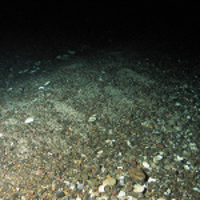
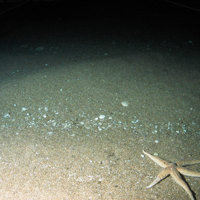
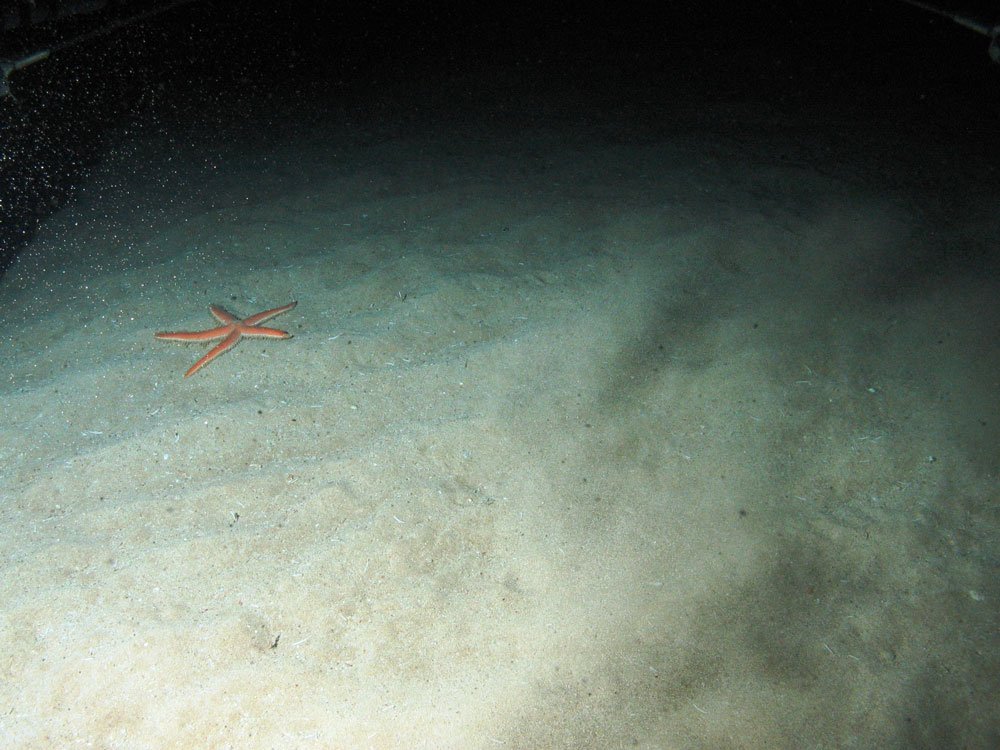
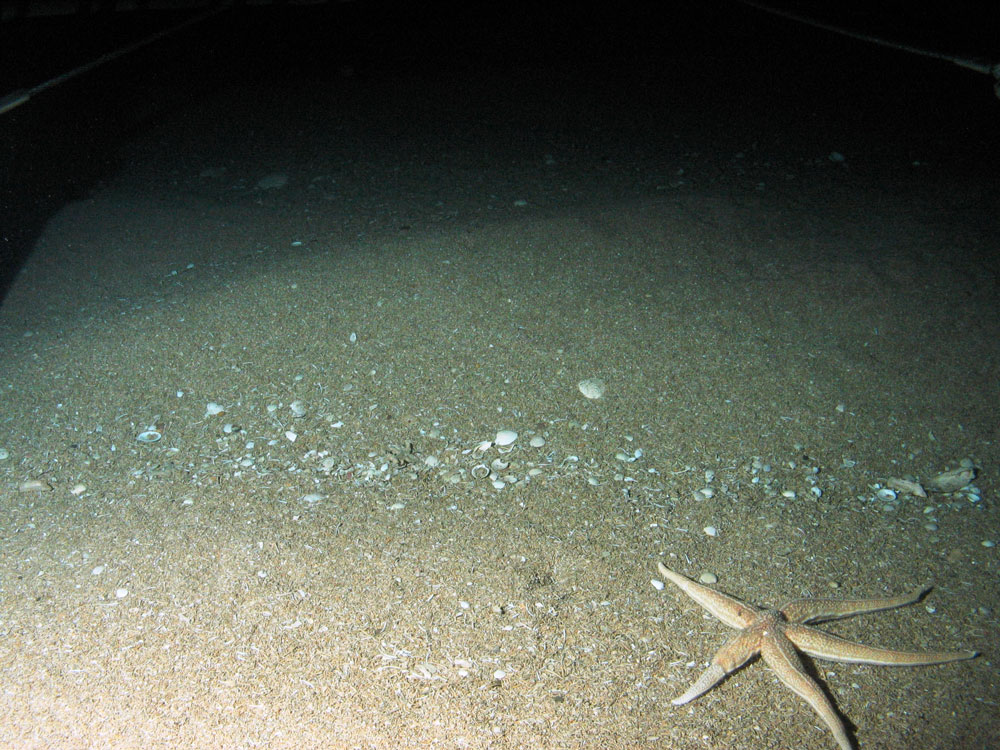
- Outer shelf and shelf break zone (135–227 m): characterised by coarse sediments ranging from strongly rippled sand and gravel plains to dense fields of cobbles and small boulders. Visible fauna is sparse in this zone and predominantly comprises echinoderms such as the pencil urchin Cidaris cidaris and sea stars.
- Upper slope zone (279–470 m): generally characterised by coarser sediments with sand and gravel patches and predominantly includes echinoderms as visible fauna.
- Ophiocten gracialis zone (600–1,020 m): a biological zone dominated by large numbers of the small brittlestar Ophiocten gracialis on fine sandy, muddy sand or sandy mud, with some areas of gravel or cobbles.
- Xenophyophore zone (1,088–1,180 m): a biological zone characterised by the Xenophyophore Syringammina fragilissima in rippled muddy sand or sandy mud.
- Decapod burrowing zone (1,293–1,595 m): a biological zone characterised by the burrows of large decapods such as Munida tenuimania in fine muds.
Further detail on the evidence for this Nature Conservation MPA can be found in the Monitoring and Evidence section.
Site location: Co-ordinates for this Nature Conservation MPA can be found in the Designation Order listed in the Relevant Documentation section.
Site area: 2,215 km2.
Site depth range: 113 m below sea-level on the edge of the Hebridean continental shelf, down to 1,757 m at the base of the Rockall Trough.
Charting Progress 2 Biogeographic Region: Scottish Continental Shelf.
Site boundary description: The MPA boundary captures the full range of sedimentary communities as they change with depth down the Hebridean continental slope in this region. The site also encompasses the geological features representative of the Geikie Slide Key Geodiversity Area. The MPA boundary encompasses all records of burrows in the area based on data from Marine Scotland Science deep-water towed video surveys, and sample locations of sea pens recorded as by-catch from Marine Scotland Science trawl surveys. The MPA boundary comprises of a corridor down the slope that captures examples of the different biological zones that characterise the Hebridean slope.
Monitoring and Evidence
Last updated: November 2023
Site specific data
There are a range of data that underpin this Nature Conservation MPA. The full overview of the data used to support site identification along with information on confidence in feature presence and extent is available in the Geikie Slide and Hebridean Slope Nature Conservation MPA Data Confidence Assessment. JNCC will be adding relevant survey data for this MPA to its MPA Mapper in due course.
All of the data available for this MPA have been generated through JNCC commissioned analysis of existing survey data. These data provide direct evidence confirming the presence of the protected features within the site.
Survey and data gathering
- Geikie Slide and Hebridean Slope MPA Monitoring Report (2022) – This initial monitoring report explores data acquired from the first dedicated monitoring survey of GSH. This data forms the first point in a monitoring time series allowing for future assessment of feature condition over time. The data will also inform the development of an effective site and feature-specific monitoring approach for the site.
Data analysis reports
JNCC commissioned analysis of available survey data are provided in the following reports:
- EMODnet – Provides supporting information on the presence and extent of sedimentary features from a predictive seabed habitat map of European waters.
- Report on the identification of key geodiversity Areas in Scottish waters – Provides information on the presence and extent of important geological/geomphological areas in Scotland’s seas, which includes the Geikie Slide Key Geodiversity Area of relevance to this Nature Conservation MPA.
- Biotope analysis of archived stills from the Strategic Environmental Assessment 7 region of Scotland’s seas.
Hughes et al. (2014) characterised the biological diversity of the Hebridean continental slope based on archived stills data from 1988 to 1998. The findings indicate that five distinct biological zones with associated communities that change with depth on the slope and help to define the communities that characterise the protected features of the MPA. - FRV Scotia – Hebridean Slope Marine Scotland Science Towed Video surveys (2004–2009) – JNCC commissioned an analysis of video footage from several Marine Scotland Science Nephrops stock assessment survey stations within the MPA (surveys conducted in 2004 and 2009), as well as fisheries by-catch records (surveys conducted in 2008 and 2009). These data help confirm the presence of the protected features of the site and are reported in Allen et al. (2014).
Additional relevant literature
References for further supporting scientific literature consulted during the identification of this site can be found in the Data Confidence Assessment. Please be aware that although these sources contain information in relation to this MPA, they do not necessarily represent the views of JNCC.
Knowledge gaps
As part of the UK Marine Monitoring and Assessment Strategy (UKMMAS), JNCC led the development of a UK Marine Biodiversity Monitoring Strategy, working with partners across the UK monitoring community. The Strategy spans UK territorial and offshore waters, focusing on biodiversity in the wider environment and within Marine Protected Areas. Its aim is to implement efficient, integrated monitoring of marine biodiversity to provide the evidence needed for all the UK's policy drivers.
Scottish Government's Marine Directorate, in partnership with JNCC and NatureScot, developed a Scottish Marine Protected Area (MPA) monitoring strategy. The Strategy spans Scottish territorial and offshore waters, focusing on biodiversity within Marine Protected Areas. The Strategy is supported by a series of annexes which provide more detail on monitoring methods, collaborative working, current monitoring and a two year forward look for MPA monitoring in Scottish waters.
The evidence collected during MPA monitoring surveys is used in combination with other available evidence to:
- Enable assessment of condition of the features within sites;
- Contribute to the assessment of the degree to which management measures are effective in achieving the conservation objectives for the protected features;
- Support the identification of priorities for future protection and/or management; and,
- Enable Government to fulfil its national and international assessment and reporting commitments in relation to MPAs and help identify where further action may be required.
More detail on offshore MPA monitoring can be found on the Offshore MPA monitoring webpage. A list of monitoring surveys and relevant reports can be found on the MPA monitoring survey reports webpage.
If you are aware of any additional data or relevant scientific papers for this site not listed in the relevant documentation, including the Geikie Slide and Hebridean Slope MPA Data Confidence Assessment, please contact us.
Conservation Advice
Last updated: December 2025
Further information on the approach used to develop this advice is available on our 'Conserving MPAs' webpage along with a Glossary of Terms used in JNCC conservation advice to support the use of the conservation advice packages.
You must refer to the conservation advice package for a NCMPA if you are:
- intending to carry out any licensed activity in or near a NCMPA and need to find out how to operate within the law;
- an authority providing advice on specific proposals;
- an authority responsible for putting management measures in place.
You may also find it useful to refer to the conservation advice package for a NCMPA if you are intending to carry out an activity in or near a NCMPA that does not require a license.
Note JNCC's conservation advice has undergone development and a restructure in 2025 resulting in some changes it is useful to be aware of. Amongst other changes, most notably, there are now only four documents instead of five, having merged the content previously presented in two separate documents i.e. the Conservation Objectives and Conservation Advice Statements documents into one which is called Conservation Objectives and Management Advice document.
We will engage with stakeholders to identify any lessons which JNCC can learn from customers who have used the advice, with a view to continuing to ensure it is fit-for-purpose.
The following table provides an overview of the components of the conservation advice and provides hyperlinks to each. Combined, these components form JNCC's formal conservation advice for this site and should be read in conjunction with each other. Until such times as this advice is updated, it remains JNCC's formal conservation advice for the site.
| Document | Overview |
|---|---|
| Background Information |
Explains where to find the advice package, JNCC's role in the provision of conservation advice, how the advice has been prepared, when to refer to it and how it can be used. |
| Sets out the broad ecological aims (conservation objectives) for the site, JNCC's view of protected feature condition, the conservation benefits that the site can provide if managed effectively, and the conservation measures which JNCC consider are required to support achievement of the conservation objectives stated for the site. | |
| Supplementary Advice on the Conservation Objectives (SACO) |
Provides more detailed and site-specific information and is essential reading to support the interpretation of the conservation objectives for the protected features of the site. Use this document to assess the impacts of your planned activity on the important attributes of the site. |
| Advice on Operations |
Provides information in an excel workbook on the activities capable of impacting the site's protected features and therefore achievement of the site's conservation objectives. This is a starting point for determining potential management requirements. It does not take into account the intensity, frequency or cumulative impacts from activities taking place. It simply supports an understanding of the possible adverse impacts that an activity can have on a MPA's features. Guidance is imbedded to support an understanding and use of the information provided in the workbook. Use the advice on operations to determine those pressures your activity can cause that could harm the protected features of the site. |
These documents are available on JNCC's Resource Hub.
Image Gallery

Published: