
Background
Biodiversity and human health interconnections
Biodiversity and human health are deeply interconnected.
Diverse ecosystems provide essential services that support life and well-being, including clean air and water, fertile soils, and climate regulation. Biodiversity underpins food security by ensuring a variety of crops and livestock, which helps protect against pests, diseases, and changing environmental conditions.
Important medicines often come from biodiversity. Many pharmaceuticals are derived from plants, animals, and microbes. Loss of species can mean the disappearance of potential cures.
Healthy nature and disease protection
Healthy nature helps protect us from disease.
When forests, wetlands, and other ecosystems are left intact, they keep animal populations in balance and reduce the chances of diseases spreading to people. When these environments are damaged through deforestation or breaking up habitats, humans can come into closer contact with wildlife that carry diseases, increasing the risk of illnesses like malaria or Lyme disease.
Mental health benefits are also linked to biodiversity. Access to green spaces rich in species diversity has been shown to reduce stress, improve mood, and enhance cognitive function.
One Health is an approach that recognises that the health of humans, domestic and wild animals, plants, and the wider environment are closely connected. It has been defined by the Food and Agriculture Organization (FAO), the World Organisation for Animal Health (OIE), the United Nations Environment Programme (UNEP) and the World Health Organization (WHO) as "an integrated, unifying approach that aims to sustainably balance and optimize the health of people, animals and ecosystems"
Some areas where collaboration across sectors has shown to be beneficial include:
- the emergence of infectious diseases
- antimicrobial resistance
- food security and sustainability
- environmental pollution
- land degradation
- climate change
- biodiversity loss
The One Health approach can be applied at the community, subnational, national, regional and global levels, and relies on shared and effective policy, communication, collaboration and coordination.
Applying a One Health approach can make it easier for people to better understand the co-benefits, risks, trade-offs and opportunities to advance fair and holistic solutions across sectors.
JNCC's Role in One Health
Advice
JNCC works in partnership with the country nature conservation bodies (CNCBs) through an Inter-agency Air Pollution Group (IAPG). JNCC's air pollution work focuses on:
- providing advice to Government, its agencies and other bodies on the impact air pollution has on biodiversity;
- providing evidence, sometimes through commissioned research, about the impacts of air pollution on biodiversity; and
- promoting better integration of policies on air pollution and biodiversity.
As the linkages between health and biodiversity are increasingly recognised, JNCC provides advice to the UK Government on international agreements, for example:
- Ensuring linkages between biodiversity and health are included in resolutions/decisions of Multilateral Environmental Agreements (MEAs) such as CBD, CITES and UNEA Ensuring the WHO Pandemic Agreement and the G7 Health Ministers’ Communique includes references to biodiversity and commitments under CBD.
In addition, JNCC are involved in progressing health-related CBD outcomes, including supporting implementation of the Kunming-Montreal Global Biodiversity Framework (GBF) which includes commitments on health. The UK Biodiversity Indicators (UKBI) were last reviewed in 2025 in response to the adoption of the GBF, and contains some health-related indicators such as the 'Air Pollution' and 'Marine pollution' indicators
Research and collaboration
JNCC has a strong track record of collaborating with international partners to deliver environmental programmes overseas.
- Environmental Pollution Programme, South Africa: Researching the impacts of solid waste and wastewater to support pollution reduction and improved waste management.
- Nitrogen Futures: Led a comparative analysis of recent and potential nitrogen‑reduction policies to maximise benefits for ecosystems and nearby communities.
- Emerging Infectious Diseases (EIDs): Working with APHA to assess how Earth Observation can support horizon scanning for EIDs, using West Nile Virus as a case study and exploring wider disease drivers.
- Bird Flu (HPAI H5N1): Contributing to UK-wide working groups by providing evidence from national monitoring schemes and partnerships with BTO and RSPB.
- Zoonotic Risk in Wildlife Trade: Collaborating with UNEP‑WCMC to assess the zoonotic potential of CITES-listed species in legal and illegal trade, focusing on taxa associated with human health risks.
- One Health Collaboration: Participating in cross-government groups to strengthen links between human, animal, and environmental health sectors.
One Health Case Studies
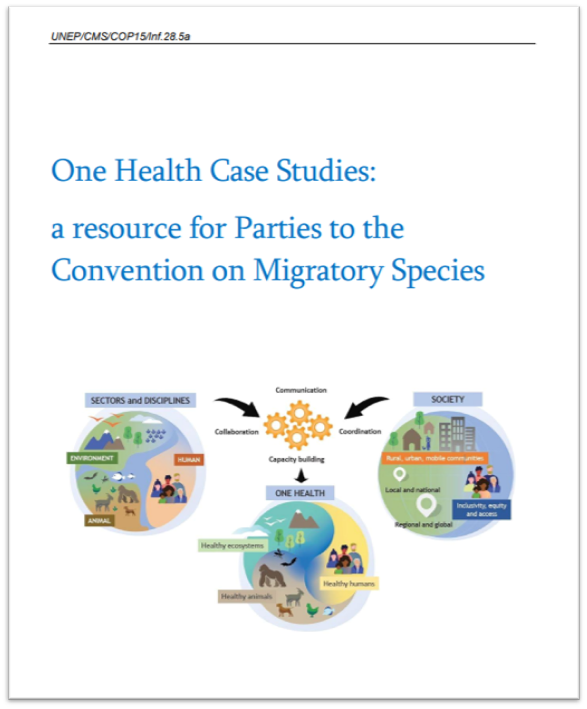
The Convention on Migratory Species (CMS) One Health Case Studies report, which JNCC was a co-author of, provides practical examples that illustrate how a One Health approach can strengthen the health of people, animals, and ecosystems. It complements CMS guidance on wildlife health by demonstrating how integrated, cross sector collaboration can address key challenges such as disease drivers, health risks at livestock/human and wildlife interfaces, and non infectious threats (e.g. pollution).
The case studies highlight how One Health methods can improve preparedness, planning, and response, enhance reporting and information sharing, and fill critical knowledge gaps for migratory species conservation. The work also emphasises the importance of international and regional cooperation and the need for improved access to wildlife health data and targeted funding. Collectively, the examples show how adopting a One Health approach can help CMS Parties more effectively safeguard migratory species while promoting broader environmental and public health resilience.
Published: .