
Our latest blog post is from our Marine Species Team, who reflect on the growing impact of the JNCC and ORCA partnership, which is helping to bridge the evidence gap for marine mammals.
UK waters are home to a huge diversity of marine mammal species, yet, despite decades of research, important gaps remain in our understanding of the distribution and abundance of our whales, dolphins and porpoises. Dedicated scientific surveys provide vital evidence, but covering such a large and changing marine environment is difficult and costly.
The need for better evidence was highlighted in the UK’s Marine Strategy Part One assessment in 2019. It found a mixed picture for marine mammals: Good Environmental Status had been achieved for some populations, but there was still insufficient information to determine the status of many. Improving our ability to assess marine mammal populations remains an important task, as this forms the basis our decision on how best to manage our oceans with their conservation in mind. Ships already travelling through these waters offer another opportunity to observe wildlife and build the evidence needed for its conservation.
That is where the partnership between JNCC and ORCA is so valuable.
Turning voyages into opportunities
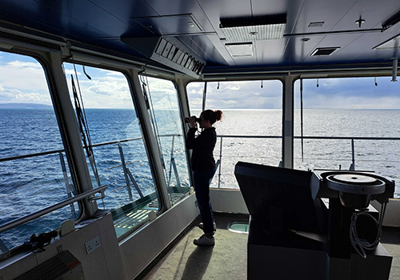 Through the JNCC and ORCA partnership, trained Marine Mammal Surveyors gather observations from commercial vessels travelling regular routes around the UK and beyond. These ships give surveyors access to waters that may otherwise be visited infrequently, helping to add to the evidence collected through dedicated research programmes.
The first phase focussed on piloting year-round surveys on the ferry network operating around the UK which was a success, and now an ongoing aspect to data collection which will bring new evidence to understand seasonal patterns in abundance and distribution. This next phase focuses on cruise ships, with a particularly promising new chapter taking place aboard Saga ocean cruises.
Four aboard!
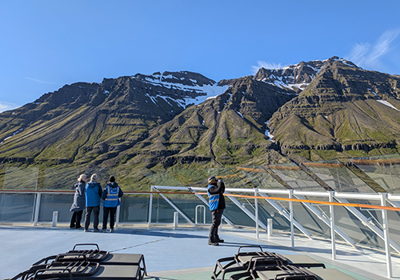 ORCA places teams of four Marine Mammal Surveyors aboard Saga vessels, where they carry out dedicated surveys while also sharing what they see, and why it matters, with guests on board. This dual function adds an additional element to the gathering of data, whereby passengers are engaged whilst at sea, with the possibility of sighting these animals for themselves and gaining an understanding of why the evidence is important.
Excitingly, the partnership has introduced bridge-based surveys, taking the programme's scientific contribution to the next level. This established survey method goes beyond simply recording animal sightings, but assesses the observations in detail noting the distance and angle of each sighting from the vessel, alongside other details of survey effort and environmental conditions via a method called ‘distance sampling’. This proven method allows scientists to account for animals that go undetected and produce more robust and realistic estimates of species density and abundance. This level of data has great potential to support growth of the evidence base to deliver improved certainty through status assessments.
That is an important step. A sighting tells us that an animal was there. Systematic survey data can help us understand how many animals may (or may not) be using an area, including offshore waters where evidence is often harder to gather.
Cruise voyages create opportunities to collect these data across extensive areas and at different times. The surveys complement existing monitoring programmes and build on ORCA’s long experience of gathering marine wildlife observations from vessels.
Evidence that can help protect marine mammals
Better information about where marine mammals occur, how numerous they are and how their populations change over time can support assessments of species status and help identify important habitats. It can also inform decisions about conservation measures as pressures on the marine environment continue to grow.
There is still much to learn, especially in offshore waters but every robust survey adds another piece to the picture. By bringing together JNCC’s scientific expertise, ORCA’s trained, highly experienced volunteer teams and the opportunities provided by Saga’s vessels, this partnership is helping turn time at sea into evidence for marine mammal conservation.
Images in the blog post courtesy of ORCA; humpback whale image courtesy of Nikki Taylor (JNCC)
Published: