
By Kerstin Kröger
Our latest blog post is from Kerstin Kröger. In this post, Kerstin celebrates the Agreement under the United Nations Convention on the Law of the Sea on the Conservation and Sustainable Use of Marine Biological Diversity of Areas beyond National Jurisdiction – also known as the BBNJ Agreement – which entered into force on 17 January 2026
Earlier this month (17 January 2026), the Agreement under the United Nations Convention on the Law of the Sea on the Conservation and Sustainable Use of Marine Biological Diversity of Areas beyond National Jurisdiction came into force. Also known as the Biodiversity Beyond National Jurisdiction (BBNJ) Agreement or sometimes referred to as the High Seas Treaty (although the remit of BBNJ is wider than just the High Seas), this momentous event feels very special to those working in the area of global ocean governance and marine science.
The feelings of hope and careful optimism that come with this new international agreement, are mixed with sadness over the passing of Dr Kristina Maria Gjerde who was so instrumental in getting discussions on and negotiations for BBNJ on its long way.
What is the BBNJ Agreement
BBNJ is an implementation agreement to the United Nations Convention on the Law of the Sea (UNCLOS). As an implementing agreement, it was created with the purpose of expanding on some of the obligations within UNCLOS, specifically on the topic of biological resources of the high seas and ‘the Area’, i.e. the seabed beyond national jurisdiction.
But BBNJ is so much more: we now have a legally binding international agreement to conserve and sustainably use biodiversity in the two-thirds of the ocean that fall outside any nation’s jurisdiction. This is truly an achievement to celebrate.
The long way to BBNJ entering into force
Like most Multilateral Environmental Agreements (MEAs) it took a long time to get to the adoption of the BBNJ – nearly 20 years. Unlike most MEAs, it only took around 15 months for the necessary number of countries to ratify it. Hence BBNJ enters into force just two and a half years after it was adopted.
Discussions on BBNJ started in 2004 following a decision by the UN General Assembly to establish a working group to study issues relating to the conservation and sustainable use of marine biological diversity beyond areas of national jurisdiction. After 19 years of discussions and negotiations, the BBNJ Agreement was adopted by consensus on 19 June 2023, and the UN opened it for signature in September 2023. Morocco was the ‘magic’ 60th country to ratify BBNJ (for international agreements, it is common to stipulate a minimum number of countries ratifying the agreement in question) on 19 September 2025. And with this, the last hurdle was taken for BBNJ to enter into force 120 days later. This special day was on 17 January 2026. One day before BBNJ entered into force, it had 145 signatories and 83 ratifications.
Where does BBNJ apply?
As an UNCLOS implementation agreement, BBNJ does not apply to national waters (i.e., a country’s 200 nm Exclusive Economic Zone, its continental shelf or its extended continental shelf). Instead, it applies to the management of the marine biological resources, i.e. marine biodiversity, of both water column and the seabed in areas beyond national jurisdiction. This equates to nearly half of the Earth’s surface (see Figure 1).
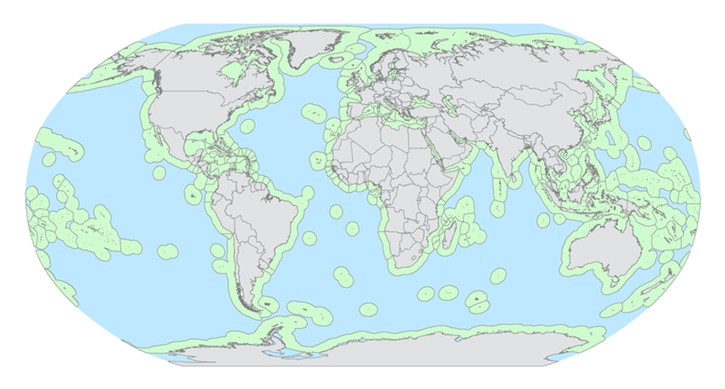
Figure 1. Ocean areas beyond national jurisdiction, shown in blue, cover approximately 45% of the Earth’s surface; in green, countries' Exclusive Economic Zones (200 nm from baseline) © White & Costello (2014)
What is BBNJ supposed to do – and why does it matter?
The main objective of BBNJ is ‘to ensure the conservation and sustainable use of marine biological diversity of areas beyond national jurisdiction, for the present and in the long term through effective implementation of UNCLOS and further international cooperation and coordination’. Most importantly, BBNJ provides the legal framework to implement measures to support maintaining and restoring ecosystem integrity in the oceans.
In reality this means:
- we now have the means to implement Marine Protected Areas (MPAs) in the High Seas;
- any activity in the High Seas that may cause substantial pollution and/or significant harm or change to the environment, requires an Environmental Impact Assessment (EIA);
- a framework for facilitated access, utilisation and benefit sharing of marine genetic resources in areas beyond national jurisdiction;
- enhanced centralised access to data and scientific information via the Clearing House Mechanism (a digital system designed to support and facilitate the sharing of science, knowledge, and information).
What are the next steps?
Now we have the treaty in place, it is time to make it work. And this is the hard part. The ‘working horse’ of BBNJ will be the Conference of the Parties (COP), the first meeting of which is supposed to occur within a year of BBNJ coming into force. Since 2025, countries have been holding preparatory meetings to get ready for this, with their next meeting scheduled for March 2026.
The first COP will have to decide on big questions centred around its rules of procedure, finance and other institutional modalities. Other major issues include sharing of benefits from the sustainable use of biological resources; setting up a regime for genetic resources; financing the agreement; including innovative and sustainable finance for tools or measures to manage human activities such as Area-based Management Tools which includes MPAs; international cooperation as well as cooperation arrangements with relevant legal instruments and frameworks; relevant global, regional and subregional bodies); and setting up a Clearing House Mechanism.
Where is the UK in this?
The UK has been supportive of the BBNJ negotiations and signed it in September 2023. Signing a treaty or agreement indicates a country’s non-binding intent to comply with it. The UK are committed to ratifying the Agreement as soon as possible and introduced new legislation in order to do so. This legislation was introduced on 10 September; it will enable the UK to implement its obligations under the BBNJ Agreement and move towards ratification. Following the passing of the BBNJ Bill, further secondary legislation will be required before the BBNJ Agreement can be ratified by the UK.
In memoriam of Kristina Gjerde
A person hugely important to the idea of BBNJ, getting it on its way and nearly seeing it through to its entry into force was Kristina Gjerde, who sadly passed away in December 2025. Kristina was a compassionate and fierce advocate for the oceans; a true ocean warrior unwaveringly committed to ocean conservation and a deeply kind person. Many of us met her, were encouraged by her and owe some of our career and passion for the oceans to her.
For decades, Kristina was the International Union for Conservation of Nature (IUCN) High Seas Adviser and represented the organisation at many international fora, including the International Maritime Organization, the ISA, and off course the BBNJ negotiations.
Together with Rena Lee, the Singapore Ambassador for International Law and Chair of the BBNJ negotiations), Kristina shaped the governance of our global ocean. For this the prestigious Elisabeth Haub Award for Environmental Law and Diplomacy was jointly awarded to both in 2024.
Kristina, who passed away on the 26 December 2025, sadly did not see BBNJ coming into force, but I hope the certainty of this happening gave her solace and peace. Kristina, we cannot thank you enough for all you gave to the world. The BBNJ Agreement is your legacy.
Published: